A recent post argued that the biggest mistake indie hackers make is shipping new products while the last one still struggles. I pushed back.
I prefer a barbell strategy: spend about 90% of your effort on the project that has already shown signs of working, and use the other 10% to run cheap tests on new ideas.
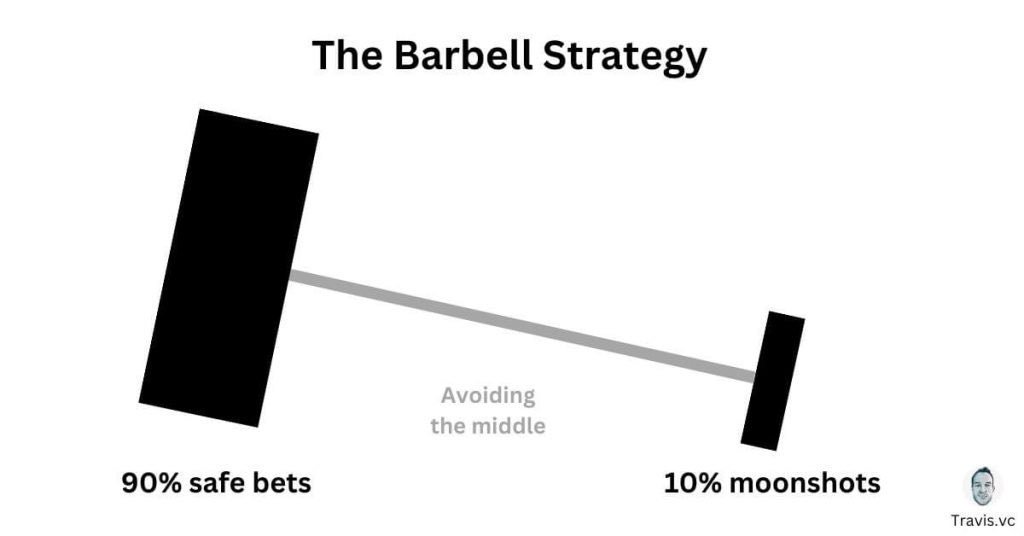
But what counts as “cheap”? A test can cost almost nothing in cash and still waste weeks of your time. It helps to put numbers on it.
Start with two rough numbers
First, estimate the value of the project. Say you think it has a 5% chance of producing $100,000:
That is a rough estimate, not a valuation. Its purpose is to give you something to update as you learn.
Second, value what you would give up. If you work on a side project outside business hours, your salary is not the right benchmark. You cannot necessarily exchange those evening or weekend hours for more salary.
The real alternative might be training that advances your career, meeting people in your industry, improving a micro-SaaS that already makes $5,000 a month, or simply exercising, resting and spending time with people you care about.
Most of those do not have a neat dollar price. One workaround is to set a personal reservation rate: the minimum value an hour on a new project must offer before you are willing to give up that time. If you set it at $50, a ten-hour experiment costs you $500 of scarce free time.
The estimate will be imperfect. That is fine. Treating your free time as worthless is much less accurate.
Price the next test
Suppose a test takes ten hours and costs another $500 for ads, data or a prototype. At a personal reservation rate of $50 an hour, its real cost is:
Now suppose fully pursuing the project would require another $5,000, and a successful outcome would be worth $100,000.
Before the test, you believe the chance of success is 5%. The project’s expected gross value is therefore $5,000, exactly equal to the cost of pursuing it. There is no margin of safety.
The test could change the decision. You estimate an 80% chance of a weak result, which would reduce the probability of success to about 1%. You would stop. There is also a 20% chance of a strong result, which would raise it to 20%. In that case:
After subtracting the $5,000 needed to pursue the project, the strong result is worth $15,000. Because you expect that result 20% of the time:
Finally, subtract the $1,000 cost of the test:
The test does not magically create $2,000 in profit. Its value comes from the decision it enables: abandon the idea when the evidence is weak, and make the larger bet only when the evidence improves.
The 2/20/200 rule
This is Rob Walling’s 2/20/200 validation framework, which he explains in episode 706 of Startups for the Rest of Us. It follows a simple progression:
- 2 hours: Research the problem, market, competitors and existing demand online.
- 20 hours: Interview potential customers and test a landing page through outreach or ads.
- 200 hours: Build the smallest usable MVP and see whether people use it or pay.
At each stage, ask whether the next step is worth the information it can give you. A cheap test has a capped downside and a decision attached to it. If the result will not change what you do next, the information is not worth paying for.